介词 思维导图
中心主题:介词
(图片来源网络,侵删)
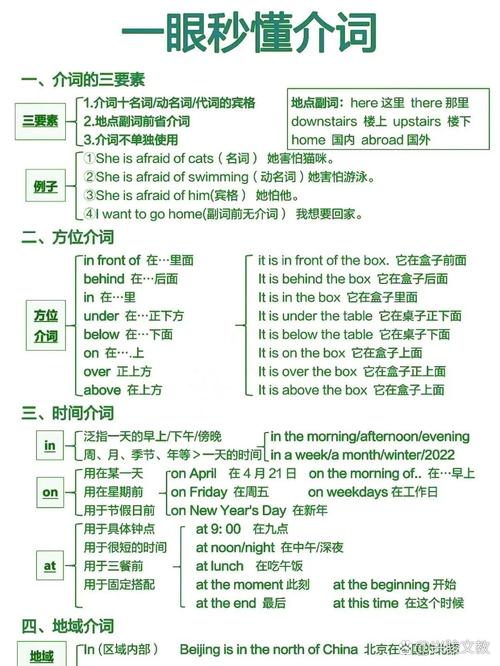
介词是什么?
- 核心定义: 表示词与词之间关系的虚词,它不能单独作句子成分,必须放在名词、代词或名词性短语前,构成介词短语。
- 功能: 在句子中充当状语、定语或表语。
- 结构: 介词 + 宾语 (介词后面的名词、代词或动名词等)。
- 例:
in the classroom(在教室里),for you(为了你),by swimming(通过游泳)。
- 例:
介词的分类
-
按功能/意义分类 (最常用)
-
表示地点/位置
in: 在...内部 (in a box, in Beijing)on: 在...表面 (on the wall, on the table)at: 在...点/具体位置 (at the bus stop, at home)under: 在...下面 (under the desk)over: 在...正上方 (over the bridge)above: 在...上方 (不一定正上方) (the picture above the sofa)below: 在...下方 (不一定正下方)behind: 在...后面 (behind the tree)in front of: 在...前面 (in front of the building)between: 在两者之间 (between A and B)among: 在三者或以上之间 (among friends)next to / beside: 紧挨着 (next to me)inside / outside: 在...里面/外面through: 穿过 (through the forest)across: 横过 (across the street)
-
表示时间
at: 在具体时间点 (at 8 o'clock, at noon)on: 在具体某一天/日期 (on Monday, on July 1st)in: 在较长的时间段 (in 2025, in summer, in the morning)for: 持续多长时间 (for two hours)since: 从...开始 (since 2025)during: 在...期间 (during the holiday)before: 在...之前after: 在...之后from...to...: 从...到... (from Monday to Friday)by: 在...之前 (截止) (by Friday)until / till: 直到...为止
-
表示方向/运动
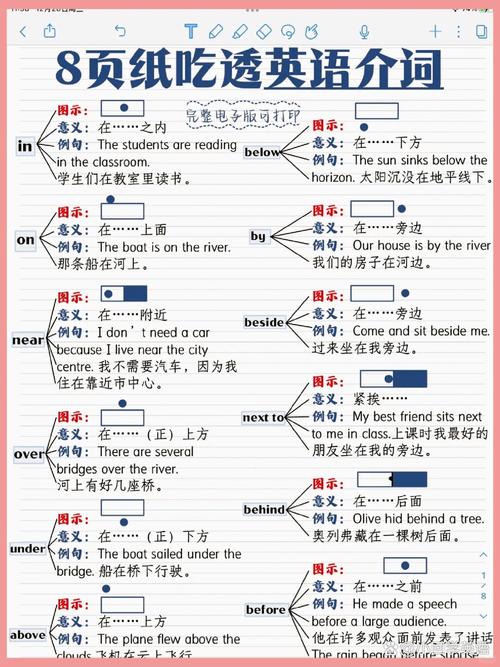 (图片来源网络,侵删)
to: 朝向,到 (go to school)from: 从...来 (come from China)into: 进入...内部 (walk into the room)out of: 从...出来 (get out of the car)onto: 到...上面 (jump onto the stage)along: 沿着 (walk along the river)through: 穿过 (walk through the park)across: 横过 (swim across the river)up: 向上 (go up the stairs)down: 向下 (go down the hill)around: 环绕 (drive around the city)
-
表示方式/手段
by: 通过...方式 (by bus, by doing sth.)with: 用...工具/带有... (with a pen, with a smile)in: 用...语言/材料 (in English, in ink)through: 通过...渠道/方式 (through the Internet)
-
表示原因/目的
for: 为了... (go for a walk)because of: 因为... (because of the rain)due to: 由于... (due to his illness)with: 因为... (with joy / with fear)
-
表示所属/关系
of: ...的 (a friend of mine)'s: 所有格 (Tom's book)with: 和...一起 (live with parents)without: 没有... (without help)
-
表示比较/对比
like: 像...一样 (He runs like the wind.)as: 作为... (He works as a teacher.)than: 比... (older than me)unlike: 不像... (Unlike his brother, he is quiet.)
-
表示其他
about: (a book about history)on: (a lecture on climate change)of: (a story of a hero)as: 作为 (He works as a doctor.)except: 除了... (Everyone except John came.)besides: 除...之外还有... (Besides John, Mary came.)
-
-
按结构分类
- 简单介词: 由一个单词构成。
- 例:
in, on, at, for, with, by, to, from等。
- 例:
- 复合介词: 由两个或两个以上单词构成,相当于一个介词。
- 例:
into, onto, upon, within, without, throughout。
- 例:
- 双重介词: 由两个简单介词连用。
- 例:
from under the table(从桌子下面),since before the war(从战争以前)。
- 例:
- 短语介词: 由短语构成,作用相当于介词。
- 例:
in front of, because of, instead of, out of, by means of。
- 例:
- 简单介词: 由一个单词构成。
介词短语的功能
- 作定语: 修饰名词,放在名词后面。
- 例: The book on the desk is mine. (桌上的那本书是我的。)
- 作状语: 修饰动词、形容词或整个句子,表示时间、地点、方式等。
- 例: He studies in the library. (他在图书馆学习。) - 修饰动词
- 例: She is very kind to me. (她对我很好。) - 修饰形容词
- 例: In my opinion, you should go. (在我看来,你应该去。) - 修饰整个句子
- 作表语: 用在系动词后,说明主语的状态或特征。
- 例: The book is for children. (这本书是给孩子们的。)
- 例: The glass is full of water. (杯子里装满了水。)
常见介词辨析
| 介词 | 核心区别 | 例句 |
|---|---|---|
| in / on / at (地点) | in 在内,on 在上,at 在点 |
in a city, on the street, at the corner |
| in / on / at (时间) | in 较长时段,on 具体日期,at 具体时刻 |
in May, on May 1st, at 5 p.m. |
| across / through | across 表面横过,through 内部穿过 |
swim across the river, walk through the forest |
| besides / except | besides “除...外还有”,except “除...外没有” |
Besides me, Tom knows it. (除了我,汤姆也知道。) Except me, everyone knows it. (除了我,其他人都知道。) |
| because of / because | because of + 名词/短语,because + 从句 |
He was late because of the rain. He was late because it rained. |
| by / with (方式) | by + 方法/交通工具,with + 具体工具 |
go by bus, write with a pen |
学习技巧与注意事项
- 不要死记硬背: 结合语境理解,介词的意义非常灵活。
- 搭配记忆: 记住动词、形容词和介词的固定搭配。
- 动词 + 介词:
look at,listen to,wait for - 形容词 + 介词:
interested in,afraid of,good at
- 动词 + 介词:
- 注意固定短语: 许多短语动词和固定表达都包含介词。
- 例:
give up,look for,in fact,on time
- 例:
- 关注介词的位置: 介词短语通常放在它所修饰的词的后面。
- 多读多练: 在阅读和听力中留意介词的使用,是最好的学习方法。